5-Min Money Audit: How to Reclaim Control of Your Finances
There is a specific, quiet dread that many people feel when they open their banking app. It is the Sunday evening or Monday morning hesitation, a subtle anxiety that whispers, "What did I spend last week? Did I overspend? Did I forget about a bill?" For most, checking a bank statement feels like opening a report card, bracing for judgment.
But what if you could completely reframe that experience? What if, instead of a source of anxiety, your weekly financial review became a five-minute exercise in empowerment, clarity, and control? By borrowing a few foundational principles from professional financial auditing, you can transform the way you interact with your money. You can stop fearing your bank statement and start using it as a strategic tool to plug leaks, optimize your resources, and free up mental bandwidth for the rest of your day. This is the five-minute personal audit, a practical, highly actionable habit designed to give you command over your finances before you even tackle your daily to-do list.
Adopt the Mindset of a CFO
To understand how to execute a personal audit, we must first adopt the mindset of a professional auditor. In the corporate and diplomatic worlds, an audit is not a punitive investigation designed to catch people making mistakes. Rather, it is a systematic, objective process of verification and improvement. An auditor does not look at a ledger with judgment; they look at it with forensic curiosity. Their goal is simply to answer two questions: Does the record match reality, and is the system functioning efficiently?
When you apply this mindset to your personal finances, you strip away the emotional baggage of guilt or shame. You are not judging your past self for buying an expensive dinner or forgetting to cancel a trial. You are simply gathering data. You are acting as the Chief Financial Officer of your own life, conducting a routine diagnostic to ensure your resources are aligned with your actual priorities. This shift from emotional reaction to objective observation is the critical first step in making this five-minute habit sustainable.
Principle 1: The Rule of Materiality
The first professional principle we will apply to your weekly review is the concept of "materiality." In professional auditing, materiality is a threshold used to determine which discrepancies actually matter. Auditors do not waste hundreds of hours tracking down a ten-cent rounding error; they focus their energy on significant variances that could impact the overall financial health of the organization.
You must apply this exact same principle to your personal audit to keep it under five minutes. If you try to scrutinize every single three-dollar coffee purchase, you will experience analysis paralysis, and the habit will quickly die. Instead, establish your own personal materiality threshold. For many, this might be twenty-five or fifty dollars. During your five-minute weekly scan, you will intentionally ignore anything below this threshold. You are giving yourself permission to let the small, everyday friction of daily life pass without scrutiny. Your focus is entirely reserved for the transactions that clear your materiality threshold, because those are the items that have the power to meaningfully impact your financial trajectory.
The Mechanics of the "Scan and Flag"
With your materiality threshold set, the mechanics of the five-minute scan become incredibly straightforward. Choose a consistent time each week, perhaps Friday afternoon as you wrap up your workweek, or Monday morning with your first cup of coffee. Open your primary checking and credit card accounts.
Do not read the statements line by line from top to bottom. Instead, use a "scan and flag" technique. Let your eyes drift quickly down the list of transactions, looking only for amounts that exceed your materiality threshold. Your brain is remarkably good at pattern recognition. When you train it to look for anomalies, you will naturally spot things that feel out of place. You might notice a charge from a vendor whose name you do not immediately recognize, a recurring subscription that is slightly higher than you remember, or a duplicate charge for a service you only use once a month. The goal here is not deep analysis; it is rapid identification. You are simply flagging items that require a secondary, two-second mental check.
Principle 2: The Authorization Test
When you flag a transaction that clears your materiality threshold, you apply the second core audit principle: the authorization test. For every flagged item, ask yourself one simple, binary question: "Did I intentionally authorize this expense, and does it still provide me with value?"
This question is powerful because it addresses the two most common sources of personal financial waste: forgotten commitments and degraded value. Forgotten commitments are the silent wealth killers of the modern economy. They are the streaming services you signed up for to watch one specific show, the software subscriptions that transitioned from a free trial to a paid monthly charge, or the gym membership you vowed to use but have not visited in six months. These are what auditors might call "ghost expenses." They drain resources without providing any operational benefit. By asking the authorization question weekly, you catch these ghost expenses within seven days of their occurrence, rather than letting them bleed your account dry for months or years.
Catching "Scope Creep" in Real-Time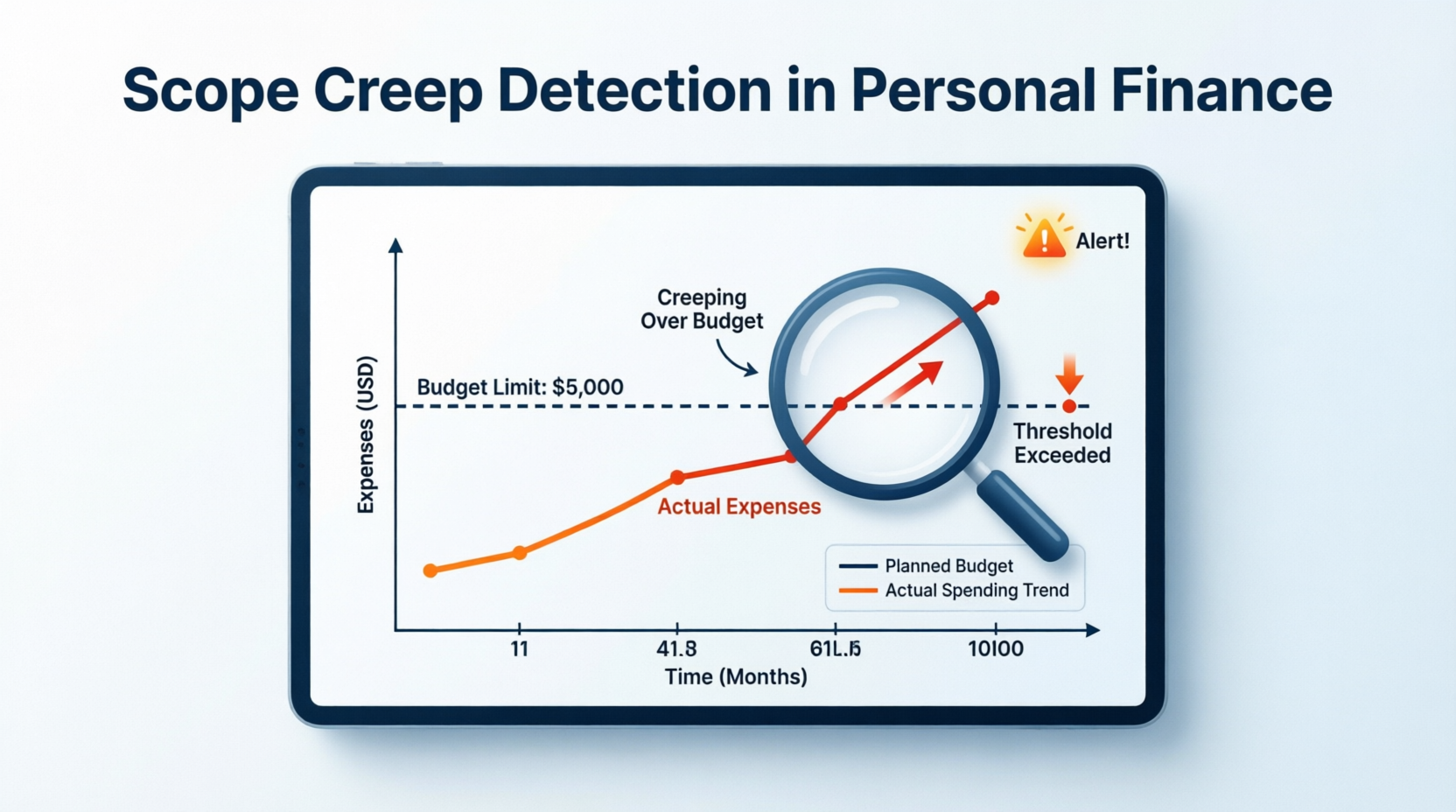
The authorization test also helps you combat "scope creep," a term borrowed from project management that applies perfectly to personal finance. Scope creep happens when a project gradually expands beyond its original boundaries, consuming more time and money than initially planned.
In your personal life, scope creep looks like a utility bill that has slowly crept up over a year, a grocery budget that has expanded because of increased reliance on convenient but expensive delivery apps, or a hobby that has quietly accumulated hundreds of dollars in new equipment. When you scan your statement and see a flagged expense that you did authorize, but the amount seems higher than usual, scope creep is likely the culprit. Catching this on a weekly basis allows you to course-correct immediately. You can decide to cook at home more often, renegotiate a bill, or consciously acknowledge that the increased spending is a deliberate choice you are making, rather than a passive leak in your budget.
The Two-Minute Corrective Action
However, an audit is entirely useless if it does not lead to corrective action. In the professional world, an auditor’s report is always followed by a management response detailing how the identified weaknesses will be fixed. Your personal audit must follow the same rule. The five-minute review is only half of the equation; the other half is the immediate, two-minute corrective action.
If you identify a ghost expense, do not tell yourself you will cancel it later. Later is the enemy of financial optimization. Take the two minutes right then and there to navigate to the vendor’s website and terminate the subscription. If you spot a duplicate charge or a transaction you absolutely did not authorize, immediately use your banking app’s built-in tools to dispute the charge or freeze the card. If you notice scope creep in a specific category, make a mental or written note to adjust your behavior for the upcoming week. The friction of taking action is lowest at the exact moment you discover the problem. By pairing the five-minute scan with immediate, decisive action, you build a powerful feedback loop that reinforces your sense of control.
The Psychological ROI: Eliminating Financial Anxiety
There is also a profound psychological benefit to this practice that extends far beyond the dollars and cents. Financial anxiety is rarely caused by a lack of money; it is almost always caused by a lack of clarity. When you do not know where your money is going, your brain fills in the blanks with worst-case scenarios. This underlying, low-grade stress drains your cognitive energy, making you less focused, less patient, and less effective in your professional and personal life.
By conducting a five-minute personal audit every week, you are actively eliminating the unknown. You are proving to your brain, on a weekly basis, that you are paying attention and that you are in command. This creates a deep, quiet confidence. You no longer have to dread the end of the month because you have already been managing the reality of your finances in real-time, week by week. You are no longer reacting to your financial life; you are directing it.
Beyond Money: Training a Strategic Mindset
Furthermore, this habit trains you to think like a strategic leader in all areas of your life. The skills you practice during this five-minute window setting thresholds, scanning for anomalies, questioning the value of recurring commitments, and taking swift corrective action are highly transferable.
You will begin to notice inefficiencies in your daily schedule with the same clarity that you notice them in your bank statement. You will become better at identifying "ghost commitments" in your calendar, those recurring meetings or social obligations that no longer serve a purpose but continue to drain your time. The personal audit is not just about protecting your money; it is about cultivating a mindset of intentionality and continuous improvement. It teaches you to regularly step back, look at the systems that govern your life, and ask the simple, powerful question: "Is this still working for me?"
How to Make the Habit Stick
To make this habit stick, remove as much friction as possible from the process. Set a recurring, fifteen-minute calendar block once a week. Treat it with the same non-negotiable respect you would give to a meeting with your most important client or a doctor’s appointment.
Ensure you are in a calm environment, perhaps with a warm beverage, where you can focus for just a few moments. Do not attempt to do this when you are exhausted, rushed, or emotionally volatile. The goal is objective observation, and that requires a clear head. Over time, this five-minute ritual will become as automatic and comforting as brushing your teeth. You will look forward to it, not because you enjoy looking at numbers, but because you enjoy the profound sense of order and control it brings to your week.
Ready for the Day Ahead
As you close your banking app after your weekly five-minute personal audit, take a deep breath. Acknowledge the small victory. You have just secured the perimeter of your personal economy. You have identified and plugged leaks, verified your commitments, and aligned your resources with your intentions. You have done in five minutes what most people avoid for months.
Now, with your financial baseline secured and your mind unburdened by the vague anxiety of the unknown, you are perfectly primed for the rest of your day. You have cleared the mental clutter, sharpened your focus, and stepped into your day with the calm, objective confidence of a leader. You are now fully ready to dive into the deeper, more complex issues of the day, knowing that your own foundation is solid, verified, and entirely under your control.