Beyond Beauty: The Brilliant Mind of Queen Cleopatra
"Her form was not incomparable. But her voice was a delight to hear." These words, written by the first century AD historian Plutarch about Queen Cleopatra, hold the key to one of the most misunderstood figures in history. For more than two thousand years, the name of the last pharaoh has been associated only with immense beauty, the art of seduction, and tragic love stories. The myth of the "beautiful queen," created by Hollywood cinema and the Roman propaganda machine, has forever overshadowed her true power: extraordinary intelligence, political acumen, and diplomatic skill. In this article, we will remove those shadows and pose the question: Was Cleopatra truly attractive because of her face or her brains? Based on archaeological evidence, contemporary documents, and modern historical research, we examine her linguistic skills, her scientific contributions, her tact in manipulating Roman leaders, and her ultimate decision to die to preserve her dignity. The true story of Cleopatra is far more fascinating than the popular myth surrounding her image.
Political Skill and State Leadership
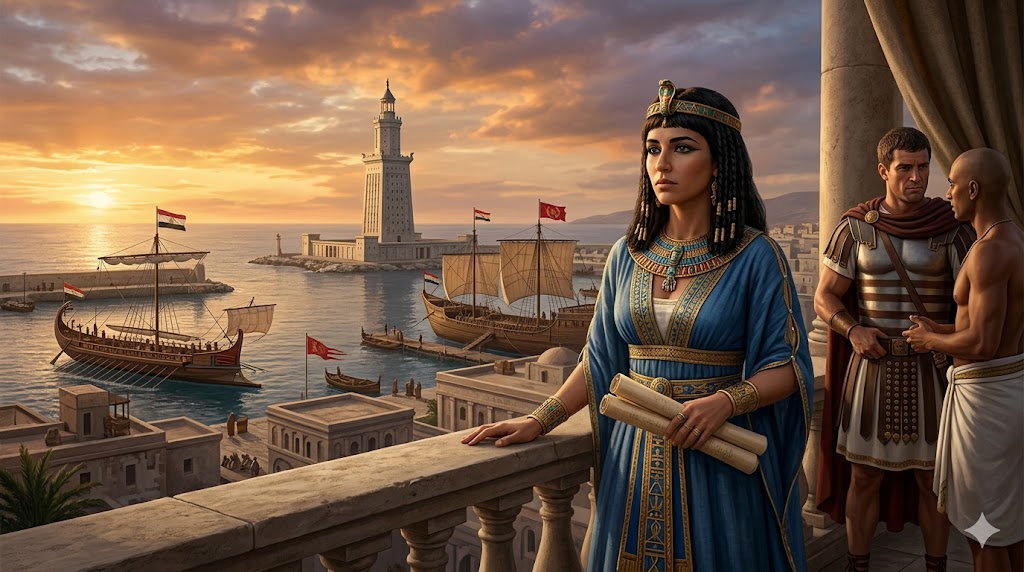
The name of Queen Cleopatra VII is usually associated with captivating tales of immense beauty. But the most important and powerful aspect of her story is that she was a stateswoman and politician who was far more intelligent and skilled than her image suggests. She not only defended the throne of Alexandria, which stood on the edge of the Roman Empire, but also worked to rebuild her kingdom from one of the most decadent dynasties in history.
Cleopatra ascended the throne in 51 BC upon the death of her father, King Ptolemy XII. At the time, Egypt was a weak state under constant external pressure from the Roman Republic. The country was deeply in debt and plagued by internal civil wars. Her first challenge was a power struggle with her brother and co ruler, Ptolemy XIII, who was only ten years younger than she was. She initially tried to push her brother aside and establish sole rule, but a conspiracy by her advisor Pothinus led to her exile.
Cleopatra's extraordinary political acumen was evident in her ability to calculate risks while in exile. When she learned that Julius Caesar, fleeing the Roman Civil War, had arrived in Alexandria, she secretly went to meet him in a carpet, according to the popular story. This diplomatic move became the most decisive moment of her life. With Caesar's help, she defeated her brother and regained power. Her relationship with Caesar was not just a love affair, but a strategic alliance for survival. Through it, she ensured the stability of her state, and later, after Caesar's assassination, she formed a similar political alliance with Mark Antony.
As historians point out, Cleopatra was a ruler who could be extremely ruthless in the pursuit of survival. She did not hesitate to eliminate her siblings, including Ptolemy XIII, Arsinoe IV, and Ptolemy XIV, in order to secure power. Although this was labeled as cruelty, from a political perspective it reflected the harsh laws of survival. During the Ptolemaic dynasty of that time, it was common for brothers and sisters to kill each other for power. Cleopatra understood how to survive in this turbulent environment. She pursued stable economic policies, generated a high annual income, and made Egypt a vital source of grain for Rome.
Language and Intellectual Abilities

Going beyond the “queen of harlots” or “oriental seductress” portrayals created by Roman historians, we find one of the most brilliant intellectuals of the Hellenistic world. History testifies that Cleopatra’s main weapons were not her looks, but her tongue and intellect. She could almost be called a scientist rather than merely a queen.
The most striking of Cleopatra’s intellectual attributes was her immense linguistic knowledge. In addition to Greek, her native language, and Egyptian, Plutarch says she knew up to six or nine other languages. This shows that, unlike many Ptolemaic rulers of the time, she refused to rely on interpreters. She communicated directly with the various peoples of her kingdom, including Egyptians, Jews, Syrians, and Arabians, in their native languages. This ability endeared her to the people and gave her a great advantage in diplomatic affairs.
Cleopatra may be the only queen in history who was also a scientific writer. There is evidence that she wrote the “Kosmetikon.” It was not a book on beauty, but an advanced study of health, medicine, and weights and measures. This suggests that she had a deep understanding of commerce, economics, and chemistry. At a time when women were denied higher education, Cleopatra’s education stands as a prime example of her extraordinary intelligence.
Even ancient writers such as Plutarch explained that Cleopatra’s appearance was not “unparalleled” or “striking at first glance.” Her appeal came from the sweetness of her voice, her eloquence, and her charm. As Plutarch describes it, “her voice was a delight to hear.” She could switch from language to language like a musical instrument. The Roman leaders who spent time with her, including Caesar and Antony, were attracted to her as a knowledgeable and engaging conversationalist rather than merely as a beautiful woman.
The “Beautiful Queen” Image Created by History
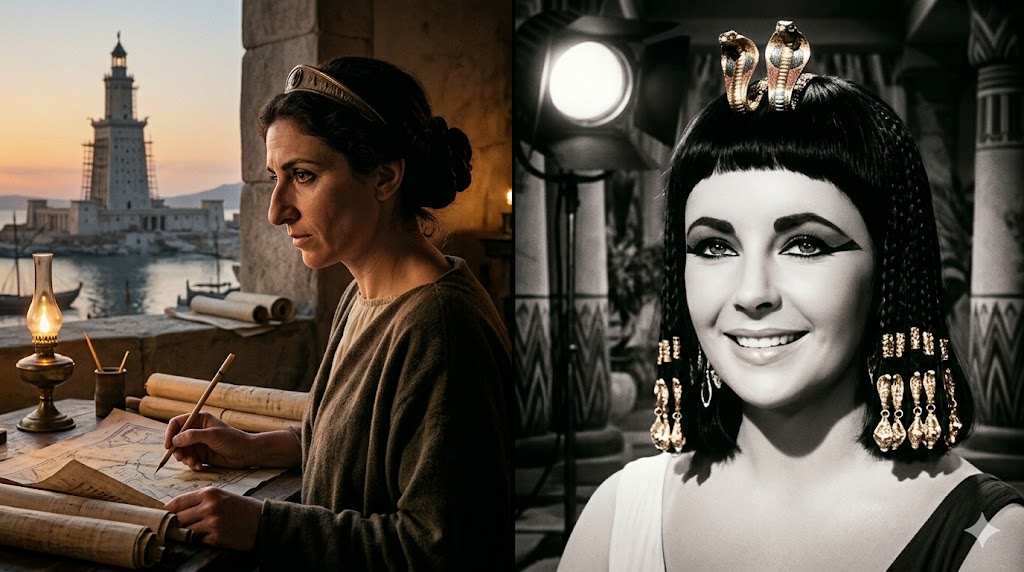
To this day, if we ask the question, “Was Cleopatra beautiful?” the majority of people would answer “yes.” However, this reputation is not a reflection of her real life, but a powerful narrative created by culture, films, literature, and the Roman propaganda machine. Many of the “facts” we know about Cleopatra’s appearance are more fiction than genuine history.
Most of the primary sources we have about Cleopatra were written by the Romans who defeated her, including Octavian and his followers. As historian Duane W. Roller points out, they portrayed Cleopatra as a “terrible oriental prostitute” in order to dismiss her ruling skills and justify their own victory. Here, the theme of her “extreme sex appeal” was used to suggest that she had weakened Antony. She was portrayed as a female trap threatening the male dominated ideals of Rome at the time.
In the twentieth century, Hollywood in particular seized upon the image of Cleopatra as a major commercial success. The 1963 film "Cleopatra" starring Elizabeth Taylor changed her image forever. These films portrayed her as a gorgeous, fair skinned, and heavily decorated femme fatale. Such depictions emphasized Western standards of beauty over historical accuracy. Her real features, as seen on coins, such as a hooked nose and thick hair, were considered unattractive and erased. It became a triumph of European aesthetics.
Cleopatra is depicted on coins with a large nose and a sharp chin. Plutarch explains that her beauty was not unparalleled. However, Western culture, influenced by Roman propaganda, has come to associate her with the concepts of both charm and physical beauty. Blaise Pascal famously said, “If Cleopatra’s nose had been shorter, the face of the world would have been different.” This statement does not mean that her appearance changed history, but rather that historians have been obsessed with her appearance. Indeed, the persistence of the “nose” debate today reflects the fact that society is often more interested in the appearance of a female leader than in her intelligence.
Cleopatra’s “beautiful queen” image is a historical device used to downplay female power. Whether she was truly beautiful or not is ultimately a relative question. What matters is that she was intelligent enough to compete with the most powerful Romans of her time. Behind the myth of beauty, the real Cleopatra was a master of diplomacy, philology, and survival. She is truly a legendary figure in history not because of her nose, but because of her brains.
Conclusion
History has betrayed Cleopatra. After her death, Roman conquerors portrayed her as a dangerous oriental temptress, and later writers, dramatists, and Hollywood productions reinforced that image, hiding her true talents from the world. But the truth is clear: Cleopatra’s greatest weapon was not her appearance, but a tongue that mastered many languages, a hand that composed a scientific treatise, and a brain that sat at the table with the leaders of the world’s most powerful empire. She captivated Caesar not with the color of her eyes, but with the sharpness of her words. She captivated Antony not with her body, but with her strategic thinking. Ultimately, her story is a lesson in how society often uses the wrong standards when assessing female leadership. To truly understand her, we must set aside the carpet story, the gold jewelry, and the label of oriental temptress, and instead see her as one of the most intelligent rulers in history.
Reference
1. Biography.com Editors. (2023, May 9). As a Ruler, Cleopatra Was as Charismatic as She Was Ruthless. Biography.
2. Roller, D. W. (2010, July/August). Impertinent Questions with Duane W. Roller. Humanities, 31(4). National Endowment for the Humanities.
3. King, A. (2023, June 18). The Reception of Cleopatra in the Age of Mass Media. World History Encyclopedia. (Review of Daugherty, G. N., The Reception of Cleopatra in the Age of Mass Media).
4. Tręda, H. (2026, April 16). Cleopatra VII – The Queen of Strategy: The Political Game for the Crown of Egypt. Archeowiesci.
5. Cleopatra’s Race and Beauty (Excerpts). (n.d.). Ravenswood Libguides.
6. Wikipedia Contributors. (2018, March 28). Reign of Cleopatra. Wikipedia.
7. Mark, J. J. (2019, September 14). Cleopatra VII. Lumos Learning.
8. Kulpa, K. A. (2021). The Egyptian Pop Queen. University of Warsaw Press.
9. Worrall, S. (2018, December 14). Egypt’s female pharaohs and what really stood behind their power. National Geographic.
10. KERA News. (2010, April 25). Forget The Temptress Rep: Here's The Real Cleopatra (Interview with D. Roller).