The Great Illusion.
Think about a one hundred dollar bill. It is just a piece of paper. You cannot eat it, wear it, or use it to shield yourself from the rain. Yet, millions of people spend forty hours a week or more working hard just to collect these pieces of paper.
This happens because of a shared social agreement. Money only has value because everyone agrees it has value. Because we all believe in it, money becomes the most powerful tool ever created. It is the invisible force that directs human energy, builds cities, starts wars, and keeps the wheels of the world turning. To understand how the economy works, we have to look behind the curtain and see how money controls the stage.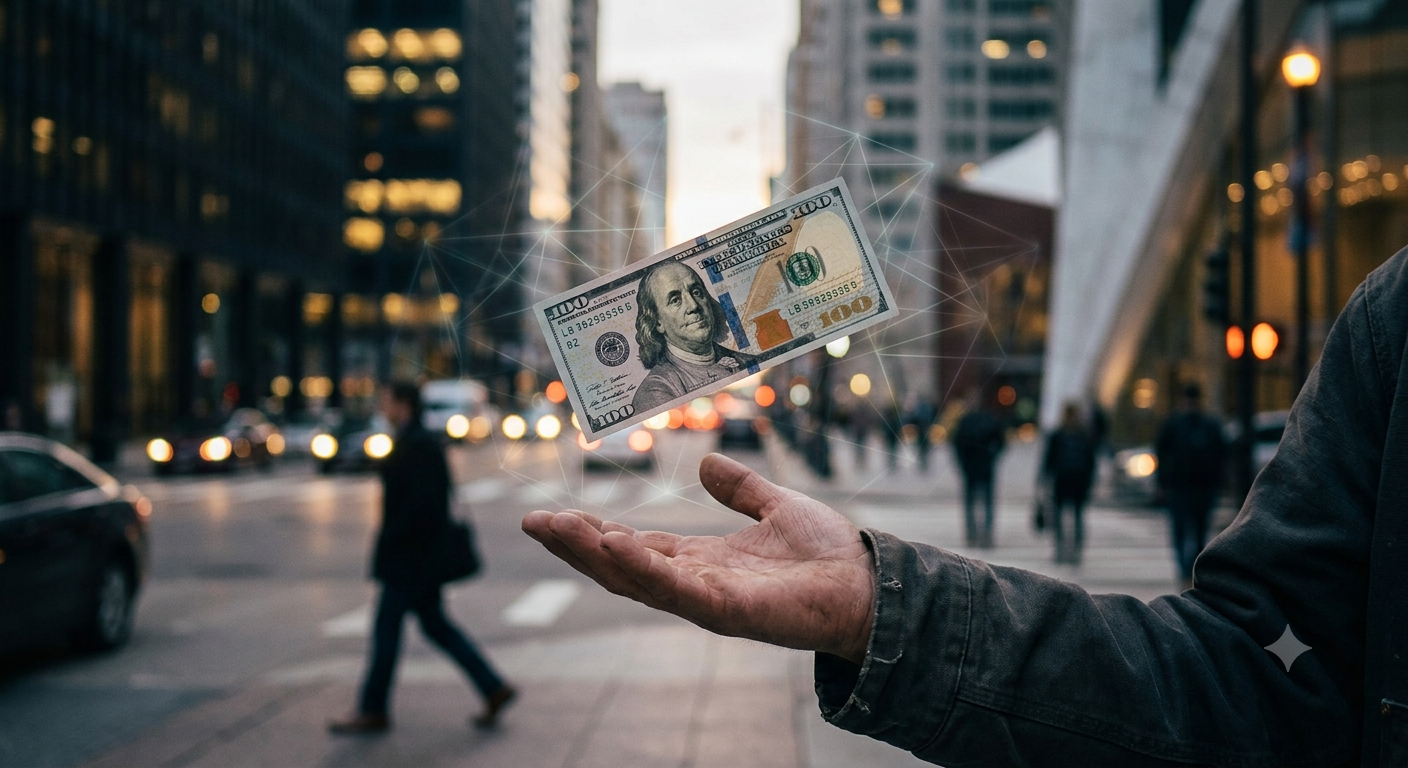
The Language of Value
Before money existed, people used the barter system. If you had chickens and needed shoes, you had to find a shoemaker who specifically wanted chickens. This was slow and difficult. Money solved this problem by becoming a universal language.
Money tells us exactly what things are worth. It allows a farmer in Brazil to sell coffee beans to a tech worker in Seattle without ever meeting or needing each other's specific goods. By acting as a standard measure, money allows billions of unrelated people to trade with one another seamlessly. When money changes value such as through inflation it is like changing the meaning of words in a language. Suddenly, everyone gets confused about what their hard work is actually worth.
The Power of Central Banks
The entire global economy has a steering wheel, and that steering wheel is held by central banks. Examples include the Federal Reserve in the United States or the European Central Bank. These institutions have a superpower. They can create money out of thin air.
Central banks control the economy using two main tools: the money supply and interest rates.
Central banks control the economy using two main tools: the money supply and interest rates.
- When the economy is slow- The central bank lowers interest rates. This makes it cheap for people and businesses to borrow money. Suddenly, people buy houses, companies hire workers, and the economy speeds up.
- When the economy is too high (Inflation)- The central bank raises interest rates. Borrowing becomes expensive. People stop spending, businesses slow down their hiring, and the economy cools off.
By turning these virtual knobs, a few people sitting in a boardroom can decide whether millions of people keep their jobs or lose them.
The Commercial Bank Multiplier
Many people believe that banks only lend out the money that other savers deposit. In reality, modern banks work much differently. When you go to a bank to get a car loan, the bank does not take physical cash out of a vault. Instead, they type numbers into a computer screen, and new money is instantly created.
This is called fractional reserve banking. Banks are only required to hold onto a tiny fraction of the money deposited with them. The rest can be loaned out to other people. This means that most of the money moving through our economy today does not actually exist as physical paper. It exists as digital promises. By deciding who qualifies for a loan and who gets rejected, commercial banks choose which neighborhoods grow, which businesses expand, and which ideas get left behind in the dark.
Driving Human Behavior and Choices
Money is the ultimate tool for motivation. Nearly every choice a person makes during the day is connected to money. Why do people wake up early and commute through heavy traffic? To earn money. Why do students study difficult subjects like engineering or medicine? Because they expect a high financial return on their time investment.
In this way, money acts as a giant traffic cop for human talent. If society values technology, large amounts of money flow into the tech sector. This high pay attracts the smartest minds to become software engineers. If a country cuts funding for teachers, money flows away from education, and talented individuals choose other careers. Money does not just buy things, it decides what types of jobs people perform every single day.
The Ghost of Inflation
To understand how money controls the economy, we must look at its greatest enemy, inflation. Inflation happens when there is too much money chasing too few goods. When the government prints too much currency, each individual unit of money loses a little bit of its purchasing power.
Imagine you saved ten thousand dollars in a safe. If severe inflation hits the country, that ten thousand dollars remains the same numerical amount, but it might only buy half the groceries it used to buy. Inflation acts like a hidden tax on your hard work. It shifts wealth away from people who save money and gives an advantage to people who own real assets, like land or factories. When inflation gets out of control, it can destroy whole societies by making regular people lose total faith in the monetary system.
Globalization and International Control
Money does not stop at national borders. It connects countries together in a massive web of dependency. The United States dollar, for example, is the world's primary reserve currency. This means that countries all over the earth use American dollars to buy essential global commodities like oil, gold, and wheat.
Because of this system, the economic choices made by one single nation can cause financial earthquakes on the other side of the planet. If the United States raises its interest rates, money from all over the world leaves developing countries and rushes into American banks to earn higher safety and returns. This can cause currencies in smaller nations to crash, making food and fuel incredibly expensive for citizens living thousands of miles away.
The Digital Shift and Future Control
The way money controls us is changing rapidly as we move away from physical cash. Today, most transactions happen via credit cards, mobile apps, and online banking. When money becomes purely digital, the institutions that control the network gain even more power.
Governments around the world are currently creating Central Bank Digital Currencies (CBDCs). Unlike traditional cash, digital money can be tracked, monitored, and even programmed. Imagine a world where your money has an expiration date to force you to spend it, or where you are blocked from buying certain items because of your political views. As money loses its physical form, the control it has over our personal choices will only become tighter and more direct.
The Mastery of the Tool
In the end, money is a tool that was originally invented to serve human beings. It was meant to make trading simpler and life easier. However, over centuries of evolution, the tool has grown so complex and powerful that it now rules over its creators.
Every factory built, every law passed, and every hour of human labor spent is guided by the flow of capital. We do not just use money to run the economy money is the economy. Understanding this reality allows us to see the world clearly. We can begin to look past the prices on the shelves and see the massive, invisible system that silently guides our daily choices and shapes our global future.